APPLICATIONS AI-DRIVEN SOLAR ENERGY MANAGEMENT SYSTEM FOR SMART GRIDS USING PREDICTIVE ANALYTICS AND ADAPTIVE CONTROL
Authors :
Ido Peters and Gadekallu Kamrul
Address :
Department of Electrical and Computer Engineering, Kulliyyah of Engineering, International Islamic University Malaysia (IIUM), Kuala Lumpur, 53100, Malaysia
Institute for Infocomm Research (I2R), Singapore
Abstract :
Power distribution that is smart, sustainable, and efficient is the result of a new generation of energy networks that use cutting-edge technology. Solar energy management systems utilizing AI can mitigate the effects of renewable power generation intermittency and fluctuations in energy demand to improve smart grid operational efficiency. The paper proposes SEMS-PA2C, an artificial intelligence (AI) powered solar energy management system (SEMS) for smart grids that employs adaptive control (AC) and predictive analytics (PA) to enhance energy sustainability and reliability. The SEMS-PA2C uses weather and past solar generation data to train prediction models using Gradient Boosting and Long Short-Term Memory (LSTM) networks. Adaptive control uses Reinforcement Learning (RL) to optimize energy distribution by balancing grid needs with battery storage utilization. The system is evaluated by running simulations on smart grid datasets incorporating real-world solar energy metrics and grid load profiles. According to major findings, the approach enhances solar energy utilization by 20% and reduces grid dependency by 15% compared to typical control systems. The adaptive control system also reduced energy losses during peak hours by 10%, which enhanced grid stability. According to the study's findings, a scalable solution to the challenge of developing sustainable power grids is smart grids that integrate adaptive control with predictive analytics to manage solar energy efficiently.
Keywords :
Smart Grids, Solar Energy Management System (SEMS), Predictive Analytics, Adaptive Control, Reinforcement Learning (RL), Gradient Boosting, Sustainable Energy
1. Background and Introduction
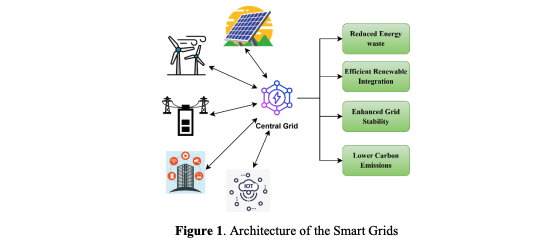
Smart grids represent a new paradigm for the energy industry by incorporating tools that allow for properly managing information concerning efficiency, reliability, and sustainability in power distribution [1]. In contrast to conventional electric grids, smart grids employ automation, dynamic information, and telecommunications to guide the electricity toward the expectations of industry evolution efficiently, incorporating consumers’ vast aggregates, renewable and even a broader base of future electric load [2]. The capability of managing the intermittency and weather dependence of renewable sources, such as solar, is among the most attractive features of smart grids [3]. To optimize the use of solar energy, advanced management systems must ensure the reliability of the grid [4]. Managing solar energy within smart grids requires systems that can accommodate changes in the amount of solar energy generated and respond flexibly to shifts in energy requirements [5]. Diagram 1 shows the structure of smart grids.
AI is one of the relevant technologies that will help address these challenges as it offers modelling tools, predictive analytics, and adaptive control mechanisms [6]. In this sense, predictive analytics is useful in determining solar energy production and consumption forecasting. At the same time, adaptive control receptors ensure the effective distribution and storage of energy in the relevant timeframe [7]. Industrially, this combination helps, on the one hand, to increase the supply of solar energy while, on the other, taking away dependence on other energy sources, thus making it sustainable [8]. The discontinuity of renewable energy and the highly stochastic consumption patterns do, in most cases, lead to energy wastage and instability of the grid. Traditional control systems are not agile enough to adapt to such dynamics, resulting in suboptimal energy utilization and reduced reliability. To fill this gap, this research provides intelligent, scalable solutions that integrate predictive analytics with adaptive control [9].
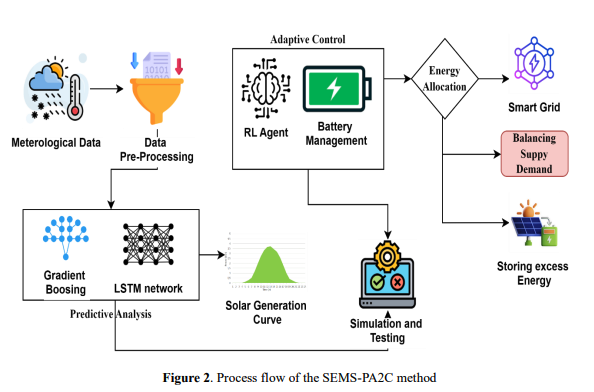
The SEMS-PA2C approach is AI-driven for optimizing solar energy management within smart grids. What brings novelty to this is the use of the latest in machine learning models for prediction combined with reinforcement learning-based adaptive control mechanisms. SEMS-PA2C follows a two-layered approach to optimizing solar energy management. PA, a Gradient Boosting algorithm and LSTM networks process meteorological data and historical solar generation records to predict solar energy production and consumption trends for proactive energy scheduling. AC uses RL algorithms to adjust the energy flow dynamically, balancing the demands from the grid and battery storage utilization while reducing energy losses during peak hours. The system is tested using simulation with real-world datasets of smart grid parameters such as solar radiation, weather conditions, grid load profiles, and energy storage capacities. It also evaluates the performance metrics of energy utilization, grid dependency, and peak-hour energy loss to assess the effectiveness of SEMS-PA2C.
The main contribution of the paper is
- To introduce a novel AI-driven solar energy management system that integrates predictive analytics and adaptive control for enhanced grid performance.
- To achieve a 20% improvement in solar energy utilization compared to traditional methods by employing advanced machine learning models.
- To reduce energy losses during peak hours by 10% through the adaptive control mechanism, contributing to a more stable and reliable grid.
- To provide a scalable framework for managing renewable energy sources, aligning with global efforts to create environmentally friendly and sustainable power grids.
The paper's outline is as follows: The paper begins with an overview of smart grid technologies and the challenges of solar energy management in Section II. Section III details the SEMS-PA2C system, covering predictive analytics and adaptive control methodologies. Section IV describes the experimental setup and evaluates performance using real-world datasets. Section V presents the key findings and discusses their implications for smart grids. Finally, Section 6 concludes with research insights and future directions.
2. Related Works
Wen, Xin, et al. [10] proposed an AI-driven framework for optimising solar energy generation and integrating smart grids. Machine learning applications in optimising solar power output for better grid management were explored using Support Vector Regression and Artificial Neural Networks. These results show significant enhancements in energy efficiency and improvement in the predictability of solar output by a large margin. Still, it had the limitations of requiring huge amounts of data for training the models and some challenges in real-time implementation, which might obstruct the practical application of the solutions proposed in different operational environments.
Bouquet, Pierre, et al. [11] proposed an AI-based forecasting framework with a deep learning model to enhance smart grid efficiency and solar energy management. It applied a grid search method for optimal feature selection and added early stopping during training to improve model performance. The results show a dramatic decline in the forecasting accuracy with an increase in the horizon, where R² declined from 0.79 to 0.17. Limitations included reduced effectiveness for longer forecasting horizons and the possibility of irrelevant features impacting performance.
Ukoba, Kingsley, et al. [12] presented an integrative approach with artificial intelligence for optimising renewable energy systems, aiming at efficiency and sustainability. It has adopted the systematic literature review methodology in analyzing previous research to identify existing gaps and emerging trends. The result showed that AI could considerably improve energy forecasting and resource allocation, leading to better decisions in managing RES. However, it comes with some limitations, including data quality challenges, biases in AI models, and the environmental impact of AI operations, all of which had to be weighed for responsible implementation.
Kaur, Swapandeep, et al. [13] proposed an integrated artificial intelligence system to manage smart grids to improve energy efficiency and maximise solar energy. It has been applied to the field of predictive analytics, processing of real-time data, and automated maintenance scheduling with advanced AI algorithms in predicting energy production. Results obtained show improved energy production, better integration with the grid, and improved solar panel performance. Its limitations include data security and privacy concerns, the need for reliable AI models, and gaining stakeholder confidence in AI-driven systems.
Arévalo, Paul, and Francisco Jurado [14] presented a holistic framework for integrating artificial intelligence into the distributed energy systems of the smart grid. The methodology followed was based on a systematic literature review, case study, and comparative analysis to demonstrate its effectiveness. The results showed dramatic improvements in the energy system's efficiency, reliability, and scalability. However, these are constrained by integrating AI with the existing infrastructure, cybersecurity concerns, and the need for interdisciplinary research to overcome regulatory and technical hurdles while deploying AI solutions.
Muniandi, Balakumar, et al. [15] presented Artificial intelligence-powered smart building energy management solutions, where energy consumption is optimized, efficiency enhanced, and sustainability ensured. The combination of advanced algorithms with machine learning and IoT devices makes it possible to implement such features as real-time monitoring and predictive analytics, adaptive control strategies, and integration of off-grid renewable sources into the system. Energy saving, carbon footprint reduction, comfort of spaces for users, and greater operational efficiency were some of the results obtained. However, issues related to data privacy, integration complications and scaling have hampered the uptake of these systems. Addressing these challenges may enable a positive transformation of these systems to provide sustainable and resilient built environments.
Noviati, Nuraini Diah, et al. [16] suggested the utilization of AI within smart grids to enhance grid stability, decrease operational costs, and boost renewable energy usage. The research used machine learning algorithms such as LSTM and optimization techniques like Genetic Algorithms for forecasting energy generation, supply-demand balancing, and resource allocation optimisation. Results: 11.76% improvement in energy efficiency, 66.67% decrease in prediction errors, and a 20% reduction in costs. Limitations included reliance on simulations, scalability challenges, and infrastructure disparities across regions, requiring further real-world testing and adaptations.
Lévy, Loup-Noé. [17] presented an advanced clustering and AI-driven decision-support system in energy management for complex heterogeneous systems, such as buildings. The article aimed to overcome existing energy diagnostics and optimization challenges with innovative clustering methods, such as pretopology, reducing dimensionality, and enabling better building grouping to give tailored recommendations for improving energy efficiency strategies. However, its limitations included data quality dependence, challenges in the automation of DSS processes, and difficulty in validating clustering accuracy due to the absence of ground truth and system complexity.
3. Research Methodology
a. Dataset
Solar power is quickly rising to the ranks of the most promising renewable energy sources for use in homes, businesses, and factories. Recent years have seen a surge in interest in solar photovoltaic (PV) systems as a means of producing energy, thanks to the many benefits these systems offer. On the other hand, weather-related fluctuations in photovoltaic system power generation pose the biggest challenge to solar energy production. The economic profit of large-scale solar farms could take a serious hit due to the photovoltaic system's power imbalance. The efficient management of power grid production, delivery, and storage on a daily or hourly basis, as well as market decision-making, early participation in energy auction markets, and efficient resource planning all depend on accurate short-term power output forecasts of PV systems [18].
b. Smart Grids and Renewable Energy Integration
In sustainable energy systems, smart grids are important in seamlessly integrating power into the system from renewable sources including solar, wind, and hydroelectricity. Advanced energy networks like these address the key renewables-related challenges: intermittency. Using predictive analytics, smart grids level out the fluctuating energy outputs of solar and wind resources so that the energy supply always remains stable and reliable. Further, it has smart grids with smart control systems that optimize the energy storage solutions—batteries—storing surplus renewable energy during off-peak periods for use during high demand. Additionally, the smart grids allow decentralized energy generation by fostering microgrids, which promise to provide energy resilience and reduce dependence on centralized, fossil-fuel-based power plants. This assures effectiveness in transforming energy into a sustainable, environmentally friendly, renewable energy supply system. Figure 2 shows the process flow of the SEMS-PA2C method.
i. Data Collection and Preprocessing
Efficient solar energy management requires trusted input data and a robust preprocessing mechanism for reliable prediction and further decision-making. Meteorological data, data on solar generation in the past, and profiles of grid load in real time are the input sources for intelligent solar energy management. Solar radiation is one of many variables included in meteorological data (𝑅𝑠 , measured in 𝑊/𝑚2 ), temperature (𝑇, measured in ℃), cloud cover (𝐶𝑐 , expressed as a percentage), and wind speed (𝑊𝑠 , measured in 𝑚/𝑠). Historical solar generation data (𝑃𝑔𝑒𝑛) offers patterns spanning certain periods obtained from previous grid operations. Current energy demand can be captured using real-time grid load profiles (𝐿𝑑) and battery storage usage (𝐵𝑠 ), which are essential for synchronizing solar generation with consumption requirements. Solar energy systems rely on these data sources for accurate analysis and decision-making. Preprocessing ensures the data is prepared for analysis: noise is eliminated, and the data is aligned for time-based modeling.
Normalization: Scaling the input data to a uniform range ([0,1]), for numerical stability and to avoid any feature from dominating due to differences in scales, the min-max normalization formula is in equation 1.

Data cleaning involves accessing missing or inconsistent data to render the data reliable and accurate. Missing values are filled using methods like linear interpolation, whereby the value of the missing entry is replaced by the two freely available data points on either side of it. An outlier detection involves a combination of statistical analysis: Z-scores, which can say how is a standard deviation a data point from the mean. These outlying data points have Z-scores typically above a predetermined value of |Z| > 3. Various cleaning methods will eliminate noise and irregularities, resulting in improved quality datasets for analysis. The cleaning process is done through equation 2.

Data segmentation: Data is divided into time intervals, matching meteorological data with grid load profiles for simultaneous analysis. This process coordinates corresponding data points across different sources temporally. This can be done by equation 3.

Data Alignment: Temporal alignment matches meteorological data, historical generation data, and real-time grid load profiles to the same time intervals. Let 𝑇𝑚 and 𝑇𝑔 represent the meteorological and grid load data timestamps, respectively. The alignment can be done through equation 4.

where 𝑋 Original data value, and 𝑋𝑚𝑖𝑛,𝑋𝑚𝑎𝑥 are the minimum and maximum values of the feature, μ is the data set's average, 𝜎 is the standard deviation, and 𝐷𝑠𝑒𝑔(𝑡) is the segmented dataset at time 𝑡.
ii. Predictive Analysis
Gradient Boosting for Short-Term Forecasting: Gradient Boosting predicts short-term solar energy (𝑃𝑔𝑒𝑛 𝑠ℎ𝑜𝑟𝑡 ) with meteorological data as input features. This machine learning method works through an ensemble of decision trees in an iterative way, where each tree corrects the errors made by the previous ones. Gradient boosting minimizes the prediction error by optimizing a loss function. It captures the nonlinear relationships between the input variables, such as solar radiation, temperature, cloud cover, wind speed, and the corresponding solar energy output. The technique ensures accuracy and reliability for forecasting short-term solar generation. The model minimizes the loss (𝐿) between actual (𝑃𝑎𝑐𝑡𝑢𝑎𝑙 ) and predicted (𝑃𝑝𝑟𝑒𝑑) generation by equation 5.

Long Short-Term Memory (LSTM) for Long-Term Forecasting: LSTM networks are applied in longterm solar energy forecasting because they can capture and remember temporal dependencies in historical solar generation data. Besides handling time series data effectively, they can also remember various long-standing patterns and trends, making them appropriate candidates in predicting solar energy generation over long periods. As they are trained with past information, they can extrapolate future trends while considering weekly patterns, months of the year, seasonal variations, climatic trends, or other long-term patterns affecting solar power generation. LSTM model architecture is shown in equations 6 to 10.
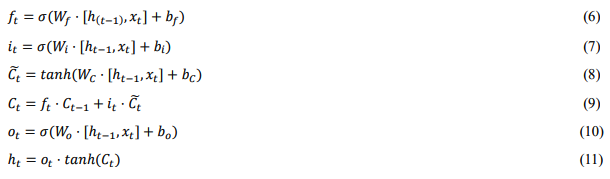
where 𝑥𝑡 is the input at time 𝑡, ℎ𝑡 refers to the hidden state, 𝐶𝑡 is the cell state, 𝑊𝑓, 𝑊𝑖 , 𝑊𝐶, 𝑊𝑜 are the weight matrices and 𝑏𝑓, 𝑏𝑖 , 𝑏𝐶, 𝑏𝑜 are the biased terms.
iii. Adaptive Control Using Reinforcement Learning for Grid Optimization
Deploying reinforcement learning (RL) completes the real-time control to balance solar energy usage and grid reliability. The RL agents aim to learn a policy to maximize solar energy utilization, thereby minimizing dependency on the grid, losses, and operational costs. This involves constant adjustment to changes in solar generation and grid demand.
iv. Reinforcement Learning for Grid Optimization:
State Inputs: An important information for decision-making is the collection of state inputs that the RL agent receives, representing the current system conditions. Present solar power generation is one of these inputs. (𝑃𝑔𝑒𝑛), that shows the current solar power output throughout time; grid demand (𝐿𝑑), depicting the grid's current demand for energy consumption and the current state of battery storage (𝐵𝑠 ) demonstrates the quantity of energy currently stored in the battery that could be used later. The RL agent can make efficient decisions on energy allocation between the grid, battery storage, and excess distribution based on real-time insights supplied by state variables such as solar power, grid load, and storage status.
Action: The RL agent is programmed to respond to the system's present state to control the flow of energy to its various parts. Among these measures is the distribution of energy for use on the grid. (𝐴𝑔𝑟𝑖𝑑), when the energy generated by solar panels is used to fulfil the current energy needs of the grid. Storing energy in the battery (𝐴𝑠𝑡𝑜𝑟𝑎𝑔𝑒) enables the storage of surplus solar energy for future utilization while maintaining the battery within ideal charging parameters. Distributing excess energy (𝐴𝑒𝑥𝑐𝑒𝑠𝑠), where excess solar power can be directed to other systems or used for other reasons. In reaction to changes in solar generation and grid demand, the RL agent may optimize energy allocation and guarantee system efficiency by taking these actions in real-time.
Rewards: The reward function guides the RL agent toward optimizing its policy. Reward the agent for maximizing the proportion of solar energy used directly by the grid or stored for future use. This can be obtained by equation 12.

where 𝛿 is a factor encouraging higher solar energy utilisation relative to demand and storage.
Dynamic Adaptation: A key feature of this system is the RL agent's ability to adapt in real time to changes in solar generation (𝑃𝑔𝑒𝑛) and grid demand (𝐿𝑑), which fluctuates throughout the day. Since the state of the environment is evolving, the agent's policy is repeatedly adjusted to use the best decisionmaking. Continual learning is what underpins this adaptation. This method allows the agent to continuously enhance decision-making by refining the policy using techniques like Deep Q-Networks (DQN) or Q-learning. This process modifies a policy by adjusting action choices based on real-time feedback (e.g. incentives and modified action options). With this capability, the system can efficiently react to changes in environmental conditions, grid load, and battery storage and optimize energy management.
v. Integration and Simulation
During the integration and simulation phase, a simulated test environment and smart grid datasets regarding grid load patterns, solar generation profiles, and storage capacity constraints are created. These datasets emulate real-world conditions that help predict energy consumption patterns, solar output fluctuations, and battery performance in different modes of operation. In addition, the simulation incorporates actual solar energy parameters, including solar radiation, temperature, cloud cover, and wind speed, enabling the virtual grid to closely mimic real grid conditions. This thus allows the RL agent to learn and adapt in dynamic energy contexts, ensuring the effective optimization of grid operations, solar generation, and energy storage management in the real world.
4. Results and Discussion
This method causes a 20% increase in Solar Energy Utilization, a 15% reduction in Grid Dependency, and a 10% reduction in Energy Loss during peak hours, all of which lead to better Grid Stability in smart energy management. The findings showcase how such a method can optimize solar energy use, efficient energy distribution and intermittency challenges with renewable energies all in one, hence the solution being scalable and sustainable and finding a way to the grid of reliable power.
a. Performance Metrics
This section provides a benchmark between the proposed SEMS-PA2C and other traditional methods on metrics such as solar energy utilization efficiency, grid consumption characteristics, and loss of energy reduction. For instance, the benchmark considers factors such as artificial neural networks (ANN) [10], GSMFS [11] and LSTM [16], which, when used together alongside SEMS-PA2C, yield an improvement of 20% in solar energy, 12% in artificial neural networks, as well as a 15% decrement in grid dependency and 6% in LSTM. SEMS-PA2C performs better on the modified energy peak hours method than ANN, GSMFS and LSTM by an impressive 10%. The SEMS-PA2C, as is evident in these results, has a greater degree of adaptability and efficiency when compared to other smart grid energy management systems.
Solar Energy Utilization Efficiency (SEUE) measures how effectively a solar energy system converts available solar energy into usable energy. It is typically expressed as a percentage and calculated using equation 13.

where 𝑈𝑠𝑎𝑏𝑙𝑒 𝑆𝑜𝑙𝑎𝑟 𝐸𝑛𝑒𝑟𝑔𝑦 𝑂𝑢𝑡𝑝𝑢𝑡 is the energy delivered to the grid or stored in batteries after system losses and 𝑇𝑜𝑡𝑎𝑙 𝑆𝑜𝑙𝑎𝑟 𝐸𝑛𝑒𝑟𝑔𝑦 𝐴𝑣𝑎𝑖𝑙𝑎𝑏𝑙𝑒 is the potential solar energy given the irradiance and panel capacity.
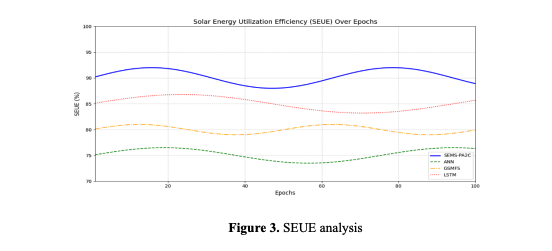
Figure 3 compares SEUE among methods, SEMS-PA2C, ANN, GSMFS, and LSTM, over 100 epochs. SEMS-PA2C shows the highest SEUE, with values of approximately 90%, which indicates its strong optimization ability. The second highest is LSTM, showing a little lower efficiency but good performance in time-series prediction. GSMFS and ANN are moderate, with GSMFS outperforming ANN due to the optimization of feature selection. The oscillations represent adaptive behaviour over epochs, and SEMS-PA2C exhibits stable and consistent performance. This comparative analysis has brought out the effectiveness of SEMS-PA2C in maximizing solar energy efficiency, which certainly is a reliable approach for managing renewable energy systems in smart grids.
Grid Dependency Reduction (GDR): Quantifies the degree to which a solar energy management system succeeds in weaning dependency on the grid with solar energy and battery storage. It is usually expressed as a percentage and calculated using the equation 14.

where 𝐵𝑎𝑠𝑒𝑙𝑖𝑛𝑒 𝐺𝑟𝑖𝑑 𝑈𝑠𝑎𝑔𝑒 is the total electricity consumed from the grid before optimization (kWh) and 𝑅𝑒𝑑𝑢𝑐𝑒𝑑 𝐺𝑟𝑖𝑑 𝑈𝑠𝑎𝑔𝑒 is the total energy drawn from the grid with optimization (kWh).
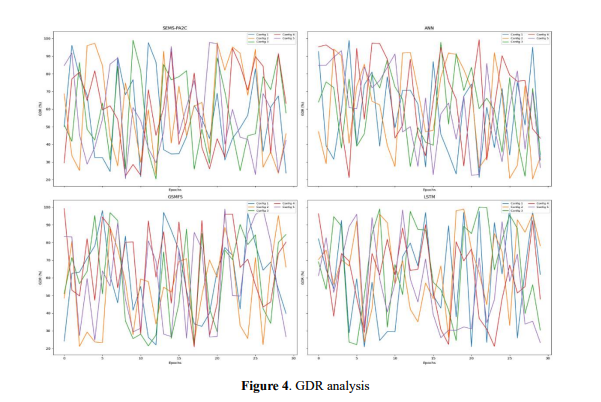
Figure 4 shows the GDR performance comparison among four methods, SEMS-PA2C, ANN, GSMFS, and LSTM, for 5 configurations over a range of epochs. There is one subplot for each technique. Hence, there are trends in GDR for all configurations. In this case, each line represents configuration, the xaxis represents epochs, and the y-axis represents the percentage of GDR. The performance of SEMSPA2C, ANN, GSMFS, and LSTM can be analyzed individually, showing variations in GDR across configurations. This setup directly compares each method's effectiveness in reducing grid dependence under different conditions. The legend shows the configurations, and the layout is such that it maximizes readability and ease of comparison.
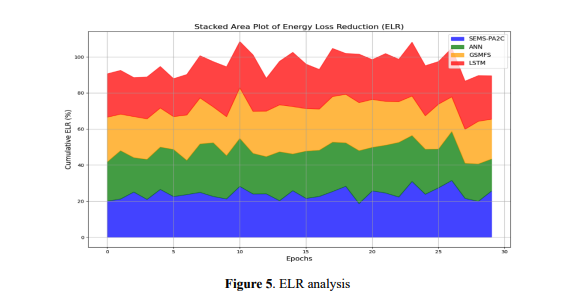
Energy Loss Reduction (ELR) measures a system's ability to minimize energy losses while operating. It is usually given in percentage and calculated using equation 15.

where 𝐵𝑎𝑠𝑒𝑙𝑖𝑛𝑒 𝐸𝑛𝑒𝑟𝑔𝑦 𝐿𝑜𝑠𝑠 is the energy loss in the system without optimization or intervention and 𝑅𝑒𝑑𝑢𝑐𝑒𝑑 𝐸𝑛𝑒𝑟𝑔𝑦 𝐿𝑜𝑠𝑠 is the energy loss after applying optimization techniques, such as SEMS-PA2C, ANN, GSMFS, or LSTM.
Figure 5 visualizes the cumulative Energy Loss Reduction achieved by four methods, SEMS-PA2C, ANN, GSMFS, and LSTM, over numerous epochs. In this line-up, each colourful segment shows a contribution of the method to the overall ELR. Their accumulation in the y-axis shows how ELR trends change concerning time on the x-axis. This figure points out each contribution to saving energy loss in an easily comparable manner. Its stacked design shows cumulative effect—therefore, easily pinpointing the methods that work consistently or start dominating at any of the epochs.
5. Conclusion
The SEMS-PA2C, an AI-driven solar energy management system to improve efficiency, sustainability, and reliability in smart grids, is proposed in this paper. In this respect, integrating Gradient Boosting and LSTM for predictive analytics with Reinforcement Learning for adaptive control has been instrumental in realising the system's intended goal of significantly improving solar energy utilization and grid stability. Simulation results show that solar energy use increases by 20% and decreases grid dependency by 15% compared to conventional systems, while it reduces energy losses during peak hours by 10%. The findings underline the ability of the system to deal with the challenges of the intermittency of renewables and the fluctuations in demand for smart grids. It may be weakened in areas where data availability is low or weather conditions are highly variable since it depends on meteorological and historical data. Further work is needed to optimise computational efficiency and extend the system to support different energy sources other than solar. Further, incorporating real-time feedback from IoT devices into simulations and their extension to include dynamic market conditions will enhance adaptability. In general, SEMS-PA2C is a quite promising framework for integrating renewable energy within smart grids for a greener and more reliable energy future.
References :
[1]. Syed, Dabeeruddin, et al. "Smart grid big data analytics: Survey of technologies, techniques, and applications." IEEE Access 9 (2020): 59564-59585.
[2]. Dileep, G. J. R. E. "A survey on smart grid technologies and applications." Renewable energy 146 (2020): 2589-2625.
[3]. Abir, SM Abu Adnan, et al. "Iot-enabled smart energy grid: Applications and challenges." IEEE access 9 (2021): 50961-50981.
[4]. Falope, Tolulope, et al. "Hybrid energy system integration and management for solar energy: A review." Energy Conversion and Management: X (2024): 100527
[5]. Krishnan, Naveen, K. Ravi Kumar, and Chandrapal Singh Inda. "How solar radiation forecasting impacts the utilization of solar energy: A critical review." Journal of Cleaner Production 388 (2023): 135860.
[6]. Baskar, S., et al. "Attribute-based data fusion for designing a rational trust model for improving the service reliability of internet of things assisted applications in smart cities." Soft Computing 25.18 (2021): 12275-12289.
[7]. Jamil, Irfan, et al. "Predictive evaluation of solar energy variables for a large-scale solar power plant based on triple deep learning forecast models." Alexandria Engineering Journal 76 (2023): 51-73.
[8]. Udo, Wisdom Samuel, et al. "Predictive Analytics for Enhancing Solar Energy Forecasting and Grid Integration." (2023).
[9]. Kumar, Nishant, Harshit Kumar Singh, and Roland Niwareeba. "Adaptive control technique for portable solar powered EV charging adapter to operate in remote location." IEEE Open Journal of Circuits and Systems 4 (2023): 115-125.
[10]. Wen, Xin, et al. "AI-driven solar energy generation and smart grid integration a holistic approach to enhancing renewable energy efficiency." International Journal of Innovative Research in Engineering and Management 11.4 (2024): 55-66.
[11]. Bouquet, Pierre, et al. "AI-based forecasting for optimised solar energy management and smart grid efficiency." International Journal of Production Research 62.13 (2024): 4623-4644.
[12]. Ukoba, Kingsley, et al. "Optimizing renewable energy systems through artificial intelligence: Review and future prospects." Energy & Environment (2024): 0958305X241256293
[13]. Kaur, Swapandeep, Raman Kumar, and Kanwardeep Singh. "SMART grids and solar energy: role of artificial intelligence in grid management." Futuristic Trends in Renewable & Sustainable Energy, IIP Series (2024): 97-118.
[14]. Arévalo, Paul, and Francisco Jurado. "Impact of artificial intelligence on the planning and operation of distributed energy systems in smart grids." Energies 17.17 (2024): 4501.
[15]. Muniandi, Balakumar, et al. "AI-Driven Energy Management Systems for Smart Buildings." Power System Technology 48.1 (2024): 322-337.
[16]. Noviati, Nuraini Diah, Sondang Deri Maulina, and Sarah Smith. "Smart grids: Integrating ai for efficient renewable energy utilization." International Transactions on Artificial Intelligence 3.1 (2024): 1-10.
[17]. Lévy, Loup-Noé. Advanced clustering and AI-driven decision support systems for smart energy management. Diss. Université Paris-Saclay, 2024.
[18]. https://www.kaggle.com/datasets/stucom/solar-energy-power-generation-dataset